WhatsApp Chatbot for Electricians That Asks About Risk First
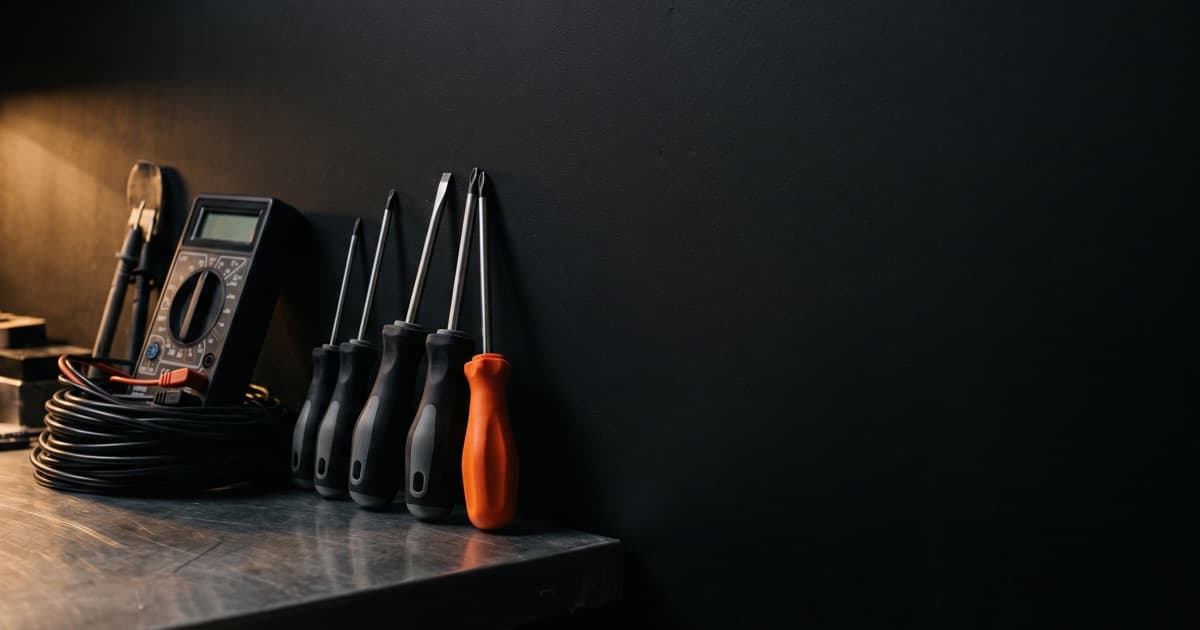
A WhatsApp chatbot for electricians answers questions. An agent does something different: before it talks about price, it asks whether there's a burning smell, sparks, or heat anywhere near the panel — because that answer decides whether the job waits until tomorrow or someone needs to cut the main breaker right now. That distinction matters in a trade where a fault isn't just inconvenient. It can be genuinely dangerous.
The first question isn't what broke
In plumbing or hairdressing, the first question is usually which service is needed. In electrical work it has to be a different one: is there a burning smell, visible sparks, or heat anywhere in the panel or at an outlet? If the answer is yes, the job stops being a normal booking and becomes an emergency — and the immediate instruction, while the electrician is on the way, is to cut the main breaker and stop all current to the property.
An agent that asks this correctly isn't diagnosing anything — it isn't judging which component failed or why. It's triaging risk with a single closed question, and that triage is what decides whether the electrician goes out within the half hour or the visit gets booked normally for the next slot. That's real safety work, and it needs no technical or clinical judgement at all.
The certificate needs a licence, not a conversation
Electrical work generally requires sign-off from a certified, licensed installer before new or altered wiring can be connected or declared compliant — the exact scheme differs by country, but the principle holds everywhere. An agent can book the visit and quote the certificate's price. What it must never do is imply that any electrician, certified or not, can issue that sign-off, or that an automated conversation replaces it.
Getting this precise, instead of leaving it vague, is exactly the kind of detail that builds trust with a customer who already knows the difference between a serious business and one cutting corners.
Why a fixed price before inspection reads like a scam
Consumer guides describing the most common electrician scams warn about a familiar pattern: someone who invents, or even causes, a fault to pressure an urgent payment, or who quotes an oddly precise fixed price over the phone without ever seeing the panel. An agent that promises a final price before a technician has set foot on site sounds exactly like that pattern, even with good intentions — the effect on trust is the same either way.
The honest pattern is the opposite: a transparent, disclosed call-out fee that gets deducted from the final bill if the customer goes ahead with the job, and no fixed quote until the electrician has actually seen the panel. An agent that applies that policy consistently, without inventing numbers it doesn't have, builds exactly the trust this trade needs.
What the agent does today — and the photo it still can't see
The agent talks over WhatsApp and Telegram, books against the real availability of a connected Google Calendar, applies discount codes, and answers with the business's real catalogue and prices, at any hour. What it still doesn't do: it doesn't receive, analyse, or generate images. It also doesn't cancel or reschedule an already-confirmed booking, and it doesn't notify staff — those still go through the electrician.
It's worth saying plainly: plenty of customers now expect to just text a photo of a scorched socket or a tripped panel. The agent can't do that yet, and we'd rather say so directly than let a customer discover it mid-conversation.
What electricians actually charge, market by market
Prices vary sharply by country and by urgency, so here's what published guides report across a few European markets rather than one invented average.
| Market | Call-out | Hourly | Certificate |
|---|---|---|---|
| Spain | €10-30 urban, up to €50 rural | €30-50/h | €70-300, typically €100-150 (Madrid €180-260) |
| France | €20-50 | €30-100/h day, €70-120/h emergency | — |
| Italy | €12-36 | €15-70/h, up to €150/h nights and holidays | — |
| Portugal | €15-65, zone-based | €20-70/h | — |
A photo of a scorched socket or a tripped panel says in one second what takes several qualifying questions over text. That doesn't exist yet — which is why we want to know if it would help your business.
Fault diagnosis from a photo
A customer sends a photo of the fault — a leak, a scorched socket, a tripped panel — and the agent uses it to qualify the job before the visit.
Related articles

WhatsApp chatbot for physiotherapy: a real calendar, not invented slots
How an AI agent on WhatsApp handles physiotherapy scheduling without diagnosing, promising appointments that do not exist, or touching clinical judgement.
Read more
WhatsApp chatbot for podiatry: maintenance and urgent care are not the same
A WhatsApp chatbot for podiatry needs to tell a maintenance visit from an urgent one. How an agent handles both, and exactly where it stops.
Read more
WhatsApp chatbot for veterinary clinics: redirect, never diagnose
A WhatsApp chatbot for a veterinary clinic should never assess an emergency. How an AI agent books real appointments and knows when to redirect, not advise.
Read more